
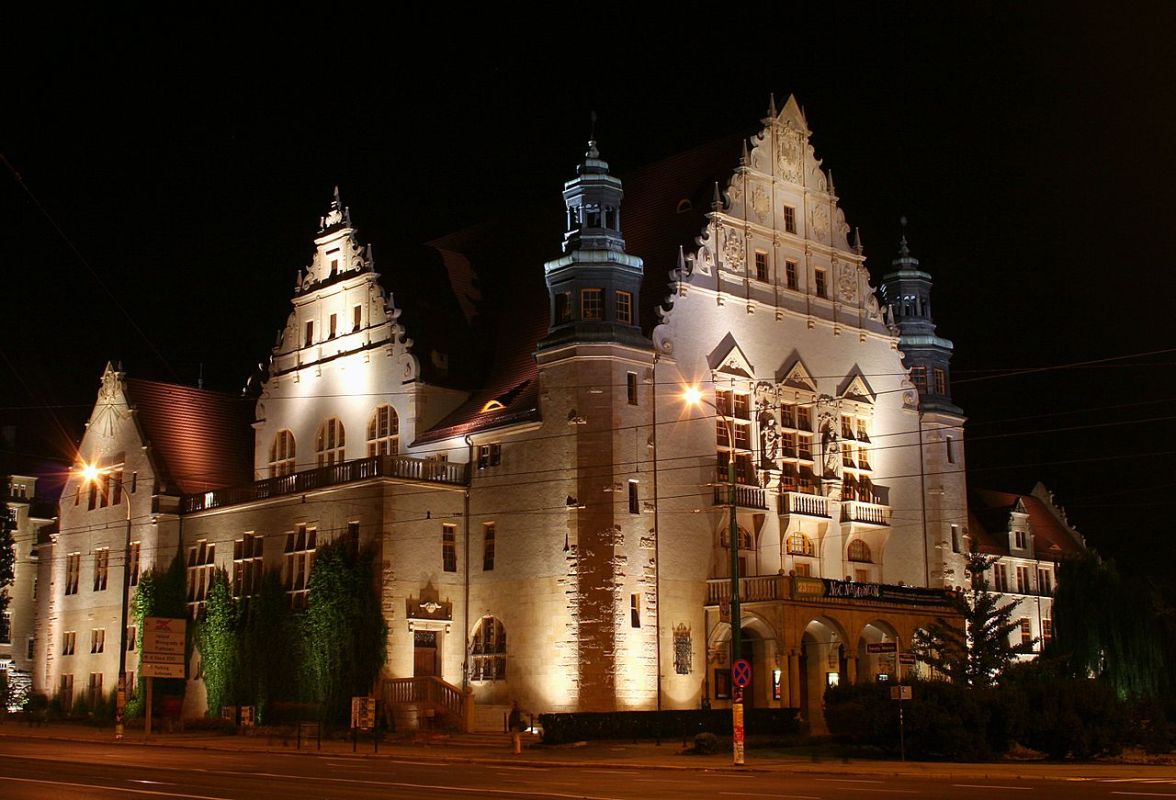

When we moved to Poland, we of course expected to encounter a new world (to us at least). That has been no less-so for me at my newest academic home, Uniwersytet im. Adama Mickiewicza w Poznaniu (Adam Mickiewicz University in Poznan). The European system is much different than what we’re used to in the states, so I though I might write a post about what I’m learning. For some of my friends with European experience, much of this is likely to be old-hat, but perhaps even they will find some differences between between Poland and elsewhere that are interesting.
First off, UAM–and its pronounced, roughly, “Mitz-kye-vitz” and not like a central European version of the proprietor of the Mouse House in Orlando–certainly isn’t the oldest university in Europe. It was founded in 1919 as the “University of the Piasts” (a reference to the first founding dynasty of Poland–Poznan lays a claim to being where Poland began). It was closed by the German invasion of 1939 and then operated for three years as a German university. Some staff and students operated their own underground university, though many of professors where executed at the Nazi death camp at Fort VII during the war (You can view Fort VII here–it’s now a museum near the airport). After the war the university was reopened. It added a major medical college in 1950 and in 1955 it adopted Adam Mickiewicz as its namesake. Today, the university boasts nearly 50,000 students all told, in locations primarily in Poznan, but also scattered over much of Western Poland. I am currently serving on the Faculty of English as a Senior Lecturer. UAM is one of the top three unis in Poland, and the English program is, I’m told, ranked within the top ten in Europe. It’s definitely exciting to be a part of it!
(Mickiewicz, by the way, was a Polish Romantic poet who did much to stoke the flames of polish identity and independence in the years after the 1798 partition, when the Prussians, the Russians, and the Austrians attempted to exterminate Poland as a country.)

Anyway, back to what university life looks like. I’ve come up through the American semester system and expanded into the eight-week, year-round, “subterm” approach used by a number of online schools. I would presume that most of my readers are familiar with one or both.
The norm here is much different. First, the entire schedule is off-set by approximately one month. Classes here begin around October 1. Winter semester (it’s gets cold here much earlier, so “Fall” doesn’t usually last long) runs until January 31stish–with a multi-day break for All Saints on October 31-November 1, a two-week break at Christmas, and various, largely unpredictable Polish holidays. Most of the month of February is taken as break, and Spring semester begins around March 1st. Spring semester runs until mid June–Easter Break is the big holiday, along with a smattering of other Catholic and Polish days off. The end of June is exams, and, after that, freedom until the end of September, when things begin gearing up again.
That will be an adjustment, of course, but it is relatively minor compared to classes themselves. When I say I have five classes, to an American academic, that sounds like a very heavy load. Thankfully, though I’m sure I’ll keep busy, it is very manageable. The courses (at least the ones I’m teaching) last an entire year, and, more importantly most of them meet just once a week for ninety minutes (I have one that meets twice in the Fall, but only once in the Spring).

To put this in perspective, this would at first seem to be equivalent to what Americans call a 5-5 load. Assuming five, three-hour courses, that would be fifteen hours in the classroom each semester, plus course prep, plus grading, plus office hours, plus committee work, plus online course development (a different animal from residential prep), plus expected research and writing, plus community service (which makes the uni look good), etc. Worse, perhaps, more than a few schools don’t pay well and therefore very often professors seek out other jobs (often online) to supplement their incomes. So, on top of all of that you likely have 2-4 online classes piled on top of everything. Ah! And don’t forget you have family and church obligations too. Sleep? It’s nice when you can get it. A big part of this, of course, is the total number of classes assigned–every extra class adds hours of weekly prep, grading, and commuting to your schedule.
(And don’t dare complain! People will assume that since you are “only” in the classroom fifteen hours a week, you are just whining about a posh position. Perhaps there are some schools that only task you the time you’re in the classroom, but I’ve never worked for a place like that. Even the ones that are explicit that they will only pay for classroom time–usually online employers–pile up outside responsibilities.)
This is much different. I’ll be teaching the equivalent of a 3-2.5 load this year. I’ll only be in class this fall for six, ninety minute sessions, most of which will be taken up with discussion and debate as the students practice their English. I have two “duty hours” a week where I have to be in my office. I will still be carrying load from my American employers, but I should have more time to myself and for my family than I’ve had in years. I might even get something written!
Another change, since I brought it up, is in university service. At my previous institution, “service” was a very vague, catch-all term for “extra work that we can expect from you, but for which you cannot expect to be paid.” (I suspect that is the same in most schools.) It could refer to something that takes an hour of your week or, in more extreme cases, thirty. Here, you are assigned one, specific extra support job and once you have it, you cannot be asked to do more. I’ll be helping with the new Writing Center (the only one in Poland, at the moment) for 2-3 hours per week, helmed by my former student and Inkling, Sabrina Haenze. (She will be the second former student to transition into one of my bosses…which I see as a good thing. I want them moving beyond where I happen to be!)

The youngest is awake and I need to take her to get some dinner, but one more quick, major difference: grading. Courses are based on year-long study, and they do not stand alone based solely on the professor’s grading decisions. In my classes, students must pass every major assignment (I’ll be using a letter-grade scale in class), but the final result isn’t simply a permanent pass or fail. If a student passes my class, I sign off on permission for them to take exams. In June, they have to pass a series of examinations in front of different faculty committees–I helped with some a week ago, and at the third-year Bachelor of Arts level. They include an extemporaneously-composed argumentative essay, a major grammar exam, and an oral exam in front of four professors. If they fail, they have to repeat the entire year. Also unlike American schools, grade inflation, while it can be a problem, isn’t nearly as bad here. Students routinely fail their exams, even if they’ve passed their classes. Sometimes 50% will fail! (The university’s response? “Study harder next time.”) So, as you can imagine, the stakes are high and the stress is intense.
More on the student load and how they differ from what I’ve seen in the states as I get to know them better. Now, off to the store!
 Meandering Meltons